
Are Polymarket Combos a Good Bet? The Parlay Trap, Explained
Polymarket's Combos feature bundles multiple bets into one all-or-nothing payout, the same structure as a sportsbook parlay. The math is stacked against you twice: your true win probability multiplies down with every leg you add, while the hidden margin in the price compounds up on top of it. Early data from Kalshi's own parlay product shows retail bettors losing about 15% of every dollar they wagered on them — roughly three times the cost of trading a single market.
This article walks through exactly how Combos work, the two mechanisms working against you, what the early loss data actually shows, and the test to run before you ever build one.
What are Polymarket Combos?
A Combo bundles two or more sports or esports outcomes into a single position. Every leg has to resolve YES, or the entire Combo pays $0 — there's no partial credit for going three-for-four. Polymarket's own Help Center describes it plainly: the payout is calculated by multiplying the implied probability of each leg together, and the fewer the chances of every leg hitting, the bigger the potential payout looks.
Combos don't trade on Polymarket's regular order book. Instead they run through a request-for-quote (RFQ) system: you submit the legs you want, competing market makers bid on the combined price within a roughly 400-millisecond window, and you get a short window — reported as somewhere between five and ten seconds — to accept the best quote before it expires. That's a meaningfully different mechanism from clicking "buy" on a normal market, and it matters, because it means the price you see was set by a market maker's model, not by an open book you can inspect.
The feature launched in beta in June 2026, following a May 2026 filing with the CFTC by Polymarket's US-regulated subsidiary. That filing caps individual positions at a $25,000 accountability threshold and states outright that if any single leg isn't satisfied, the whole contract resolves to zero — regardless of how the other legs turn out. Some outlets report a maximum of 32 legs per Combo; that figure doesn't appear in Polymarket's own documentation, so treat it as reported but unconfirmed.
One more detail worth knowing: Combos can include correlated legs from the same game — a moneyline pick and a total from the same match, for instance. There's no shared engine pricing that correlation across market makers. Each one prices it however its own model says to, which means the "fairness" of your quote depends entirely on which maker happens to answer your request.
How much do you actually win on a Combo?
Less than the payout number suggests, because probabilities multiply down.
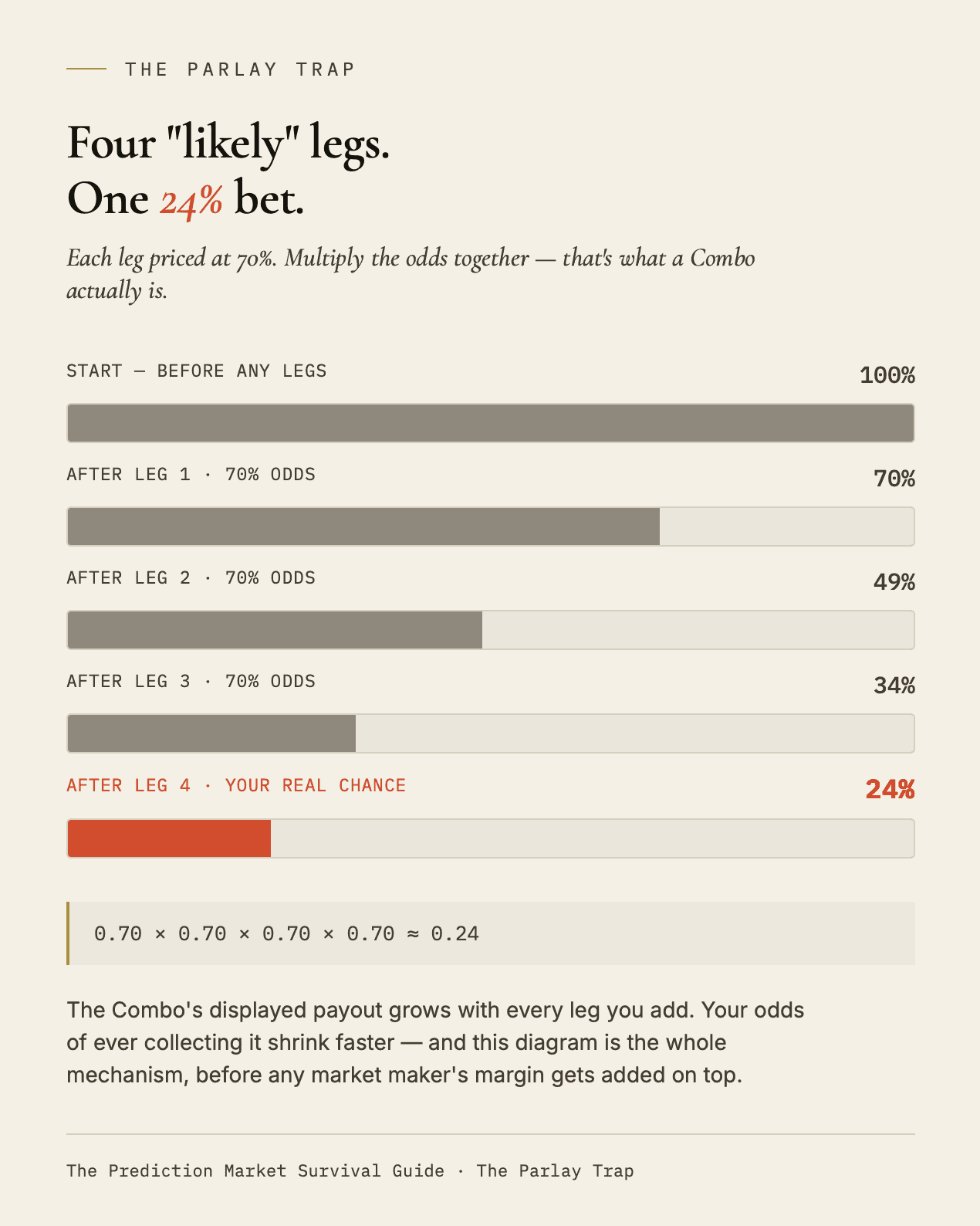
Say you build a four-leg Combo where you genuinely believe each leg has a 70% chance of hitting. Four favorites you'd happily bet individually. The chance that all four hit isn't 70%. It's 0.70 × 0.70 × 0.70 × 0.70 = about 24%. You've gone from four bets you'd call "likely" to one bet that misses more often than it hits, wrapped in a payout that looks generous precisely because the true odds are worse than any single leg feels.
This is the exact mechanism behind what the Trap Test calls the Parlay Trap: five "likely" legs at 80% each don't combine into an 80% bet. They combine into roughly a one-in-three shot. The payout multiplier is doing honest math — it's your intuition about the odds that's lagging behind.
Why does a Combo cost more than it looks like it costs?
Because on top of the probability problem, the margin embedded in the price compounds too.
A single sports bet at standard odds (-110, in American-odds terms) carries roughly 4.5% vig — the house's built-in edge. Chain legs together and that margin doesn't add, it compounds: a two-leg parlay effectively carries around 9%, a four-leg around 17%. One clean worked example: a five-leg parlay of -110 picks should pay $3,100 profit on a $100 stake with zero vig. With standard vig baked into each leg, it pays $2,435.97 instead — a 21% haircut before a single game is even played.
A smaller, more relatable number: a three-leg parlay quoted at +848 odds should, at fair value, pay +985. The gap works out to roughly −$6.29 of expected value on every $50 ticket. Place a few of those a week and you're mathematically giving away real money before the first whistle blows, win or lose.
Polymarket markets Combos as fee-light compared to a sportsbook. That's true of the itemized fee — but it misses where the actual cost lives. The market maker's margin is baked into the quote you receive, not listed as a separate line item. "No posted fee" doesn't mean "no cost." It means the cost moved somewhere you can't see it.
Are Combos the same as a sportsbook parlay?
Structurally, yes — bundled legs, all-or-nothing payout, a margin working against you the whole time. The differences are in who sets that margin and how visible it is.
Single market position | Polymarket Combo | Sportsbook parlay | |
Typical cost to you | ~5% (spread + fee) | ~15%* | ~18–31%* |
Who sets the margin | The order book — visible in the spread | Competing market makers via RFQ — mostly hidden in the quote | The sportsbook — fixed into the odds you're shown |
How correlation is priced | N/A, one position | Ad hoc, per market maker, no shared model | Priced by the book, often underpriced on same-game legs |
Can you exit early | Yes, anytime there's a buyer | Only if a market maker chooses to quote you an exit | Rarely, and usually at a poor cash-out price |
How visible is the true cost | The spread is on your screen | The margin is inside the quote, not itemized | Baked into the odds, never shown as a number |
*Figures are early proxies, not Combos-specific data — see the next section.
The dividing line isn't the platform. It's the structure. Bundling legs together is what creates the cost, whether the bundle happens on Polymarket, Kalshi, or a mainstream sportsbook.
How much have people already lost on prediction-market parlays?
Polymarket doesn't publish Combos-specific loss data yet — it's a new, beta feature running through a separate pricing pipeline. But Kalshi's older parlay product gives a close proxy for what happens once volume builds, and the numbers are blunt: retail bettors lost roughly $117 million on Kalshi parlays between January and April 2026, on about $800 million wagered — a loss of roughly $15 for every $100 risked. At least $35 million of that went directly to the exchange as fees. Parlay share of Kalshi's total volume grew from under 3% in early November to about 22% by April, meaning the product that costs bettors the most is also the one growing fastest.
One illustrative example from that dataset: an 18-leg parlay on a Timberwolves–Spurs playoff game dangled a $1-to-$185 payout. A few thousand people took it. Combined, they lost $48,000 on a single long-shot ticket. That's not a bug in the product — the long odds and the big number are the product.
Why do parlays feel good even when you lose?
Because losing a parlay rarely feels like losing. It feels like almost winning — and almost-winning is a documented psychological hook, not an accident of bad luck.
When each leg has independent odds, a multi-leg parlay is far more likely to go, say, three-for-four than a perfect sweep. That near-miss triggers a stronger emotional pull than an outright loss does, and it's the same mechanism that makes slot machines sticky: a result that just barely didn't pay keeps people playing longer than a clean loss would. If you've ever felt robbed by a Combo that died on its last leg, or immediately started rebuilding a new one to "finish what the last one almost did," that's the near-miss effect doing exactly what it's built to do — not a signal you were close to being right.
Worth being straightforward about: if you notice yourself chasing that specific feeling — rebuilding combos right after a near-miss, increasing leg count to recreate the rush, or treating a three-of-four loss as encouragement — that's worth paying attention to as a pattern, independent of anything about odds or strategy.
Should you ever build a Combo?
Rarely, and only under conditions most beginners aren't yet equipped to meet.
The test: before you build a Combo, multiply the implied probability of each leg together yourself, and compare that number to the quote you're offered. If the quote isn't at least as good as your own math after accounting for correlation between legs, you're not finding value — you're paying for the excitement of a bigger number. And only include legs you'd genuinely trade on their own. A Combo doesn't fix a leg you're unsure about; it multiplies the friction sitting underneath it.
If you do build one: keep the leg count low — two or three, not the maximum the platform allows — and size it assuming you cannot exit early. Cashing out mid-Combo depends on a market maker choosing to quote you a price, which isn't guaranteed. Treat every Combo you place as a hold-to-resolution bet, because functionally, it usually is one.
This pattern already has a name in the Survival Guide framework: the Parlay Trap — one bet, dressed up as several, sold on a payout number that's only exciting because the odds are worse than they feel. It's the same identity the Trap Test calls The Stacker. If that sounds like you, the fix isn't willpower. It's running the multiplication before you place the bet, every time, without exception.
Frequently asked questions
What are Polymarket Combos?
A feature that bundles two or more sports or esports outcomes into one all-or-nothing position, priced through a request-for-quote system rather than the standard order book. Every leg must hit for the Combo to pay out.
Are Combos the same as parlays?
Structurally, yes. Both bundle multiple outcomes into a single win-or-lose payout, and both carry a margin that compounds with each added leg.
Can you cash out a Combo before it resolves?
Only if a market maker chooses to offer you a quote to exit. There's no guaranteed exit, so a Combo should be sized as if you'll hold it to resolution.
How many legs can a Combo have?
Polymarket's own documentation says "two or more," with no stated maximum. Some outlets report a 32-leg cap; that figure is unconfirmed by Polymarket directly.
Is it ever smart to build a Combo?
Only when you've calculated the true combined probability yourself, compared it to the quoted price, and every individual leg is one you'd trade on its own. Absent that, the math runs against you by default.
———————————————
Before you build your next Combo, run the actual numbers instead of trusting the payout screen. [The Prediction Market Survival Guide] covers exactly this: sizing, edge, and the checklist that catches a Parlay Trap before you fund it.
Back to articles